About the Film
Length: 10 minutes
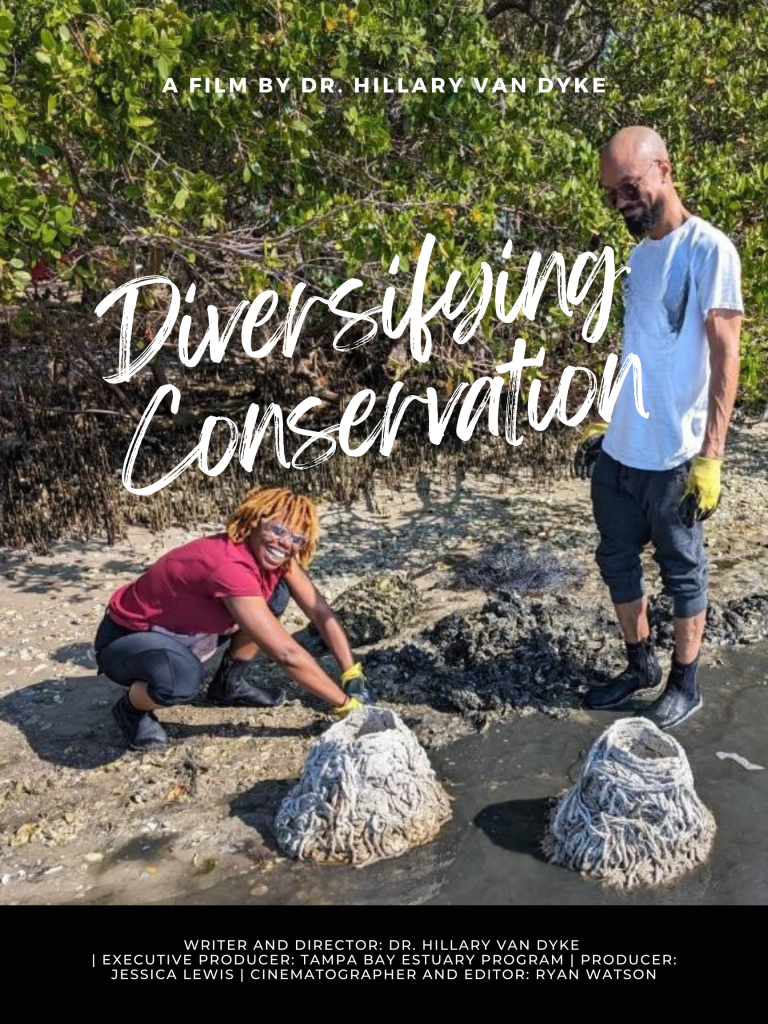
Topic: The film documents a shoreline restoration project at Philippe Park in Tampa Bay that centers the voices and experiences of Black and Brown community members, highlighting how environmental work can become more inclusive and representative.
Film Link
Learning Objectives
Students will be able to:
- Understand the intersection of identity and environmental conservation
- Analyze the role of community storytelling in environmental work.
- Identify actionable ways to participate in local environmental justice efforts.
Potential Standards
- SC.912.N.1.1: Define a problem based on a specific body of knowledge,
- SC.912.N.1.3: Recognize that the strength or usefulness of a scientific claim is evaluated through scientific argumentation, which depends on critical and logical thinking, and the active consideration of alternative scientific explanations to explain the data presented.
- SC.912.L.17.20: Predict the impact of individuals on environmental systems and examine how human lifestyles affect sustainability.
- SC.912.N.4.2: Weigh the merits of alternative strategies for solving a specific societal problem by comparing a number of different costs and benefits, such as human, economic, and environmental.
- SC.912.L.17.1: Discuss the characteristics of populations, such as number of individuals, age structure, density, and pattern of distribution.
- SC.912.L.17.3: Discuss how various oceanic and freshwater processes, such as currents, tides, and waves, affect the abundance of aquatic organisms.
- SC.912.L.17.4: Describe changes in ecosystems resulting from seasonal variations, climate change and succession.
Keywords
Conservation, community storytelling, Tampa Bay conservation, environmental education, oysters
Differentiation & Grouping Suggestions
- Homogeneous grouping for scaffolding
- Mixed‑ability groups to foster peer learning
- Provide sentence starters or graphic organizers for ELL or learning support students
- Offer challenge extensions such as deeper data dig or advocacy focus for advanced learners
Pre-Screening Activities (10 Minutes)
- Think-Pair-Share: Have students consider: Who do you picture when you hear the word environmentalist? Discuss how media and culture shape that image.
- Quick Research: Look up the history of Philippe Park or shoreline conservation in Tampa Bay. Discuss these questions: Who has seems to lead these projects in Tampa Bay? What do you notice about who is not a part of these projects.
- Viewing Guide: Tell students they are going to watch a short film. While they watch, they should take notes on the following: (1) What barriers to participation are mentioned or implied? (2) How does the visual storytelling highlight community, identity, and connection to place? (3) Anything else they want
Post-Viewing Discussion or Written Questions (10-20 Minutes)
For Whole-Class or Small Groups:
- What story is this film trying to tell beyond just a conservation project?
- How did the participants’ identities shape their connection to the environment?
- What stood out to you about the filmmaking?
- Why is it important to have community members represented in environmental projects?
For Written Reflection:
- Describe a place in nature that is meaningful to you. What makes it special, and who do you share it with?
- If you were leading a conservation project in your community, what would you do differently based on what you saw in the film?
Possible Activities (30-45 Minutes)
1. Create a Community Map
Have students create a map of natural resources or outdoor spaces in their neighborhood. Are these spaces accessible to all? What improvements would make them more welcoming?
2. Interview Assignment
Students interview a family member or community elder about their experiences with outdoor spaces. How have those experiences been shaped by their identity?
3. Environmental Storytelling Project
Students create a short video, podcast episode, photo essay, or written narrative highlighting an environmental issue in their community. Who is most affected by the issue? What solutions are already being led by community members? Optional Add-On: Host a mini class “film festival” or gallery walk to showcase student stories.
4. Direct Action in Conservation
Schedule a teach-in with Damon Moore of Oyster River Ecology and have students make oyster rag pots. Before hand, ask students what they think the benefits of being engaged in this work are. Afterwards, lead a class discussion on what they learned and how they will encourage their friends and families to get involved in local conservation.
5. Policy & Advocacy Simulation
Students role-play as stakeholders in a city council meeting deciding on a new conservation project to help storm mitigation. Roles could include:
- Community residents
- Environmental nonprofits
- Developers
- Local government officials
- Youth activists
Students present arguments and collaborate on a proposal that addresses both environmental impact and community inclusion.
Assessment Options (15-90 minutes)
1. Multiple-Choice Quiz
1. What is the primary goal of the film Diversifying Conservation?
A. To explain the science behind shoreline restoration
B. To document pollution in Tampa Bay
C. To increase community engagement and inclusion in conservation
D. To highlight career paths in marine biology
2. Which of the following best describes an example of “inclusive conservation”?
A. A restoration project led by university researchers only
B. A cleanup organized by city officials with no community input
C. A conservation project that invites local residents to share knowledge and participate
D. A national campaign with celebrity endorsements
3. According to the film, what barriers can prevent people of color from participating in environmental work?
A. Lack of outdoor interest
B. Historical exclusion and lack of representation
C. Poor weather conditions
D. Disagreement about climate change
4. Which strategy did the film highlight as effective in engaging the community?
A. Mailing out flyers
B. Conducting laboratory experiments
C. Using storytelling and relationship-building
D. Building new science centers
5. What message does the film most strongly convey?
A. Conservation is too technical for the average person.
B. Environmental work should only be led by scientists.
C. Everyone has a role to play in conservation, especially historically excluded communities.
D. Urban communities are not interested in the outdoors.
2. Alternative Project + Rubric
Project Title: Tell the Story of Conservation in Your Community
Time: 1–2 class periods
Instructions: Create a written, visual, or audio story about an environmental issue or outdoor space in your neighborhood. Your story should reflect who is impacted, who is involved, and what action is (or could be) taken. You can choose one of the following formats:
- Short essay or photo essay
- Illustrated poster with captions
- 1–2 minute audio or video recording
 Dr. Hillary Van Dyke